Track Holdings, Watchlists and Portfolio Exposure with Open Fire
Keep invested money and research ideas distinct, then review the positions that shape your portfolio.
Jenius Tech SRL
A stock portfolio tracker should show what you own, what you are only researching and how those positions combine. Open Fire puts holdings, watchlists, gains, allocation and risk information in the same workspace so those questions can be reviewed together.
Start with accurate records. A chart built from an incorrect quantity or purchase value can look convincing while describing the wrong portfolio.
Separate holdings from watchlist ideas
Investors can switch between invested positions and research ideas without mixing the two.
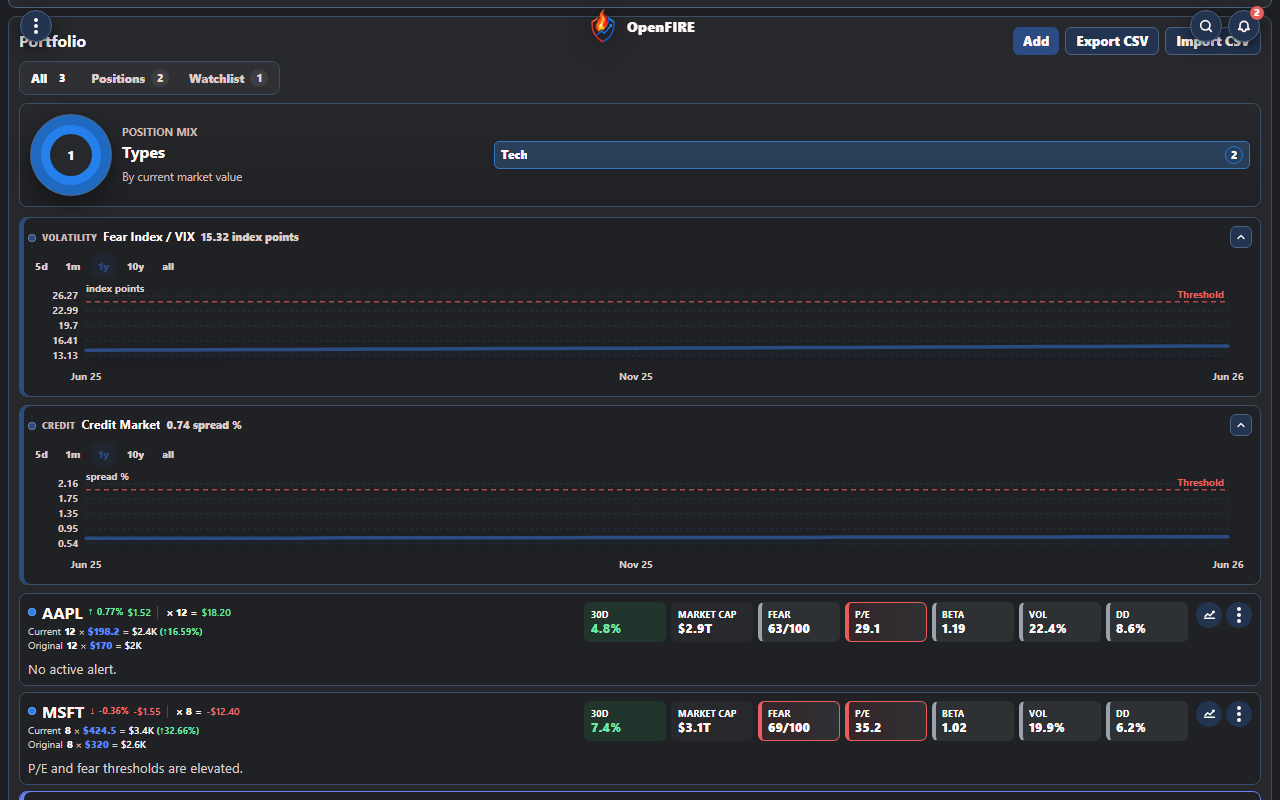
Use Open Fire’s Positions view for invested holdings and Watchlist for symbols you are following. This makes a practical difference during research: an attractive idea is not the same as an existing commitment.
When adding a symbol, decide which role it belongs to. Review the available stock search result and verify the instrument identity before recording it. Similar company names, listings and currencies deserve a closer check.
Keep the underlying records current
Compare recorded quantities and purchase information with your broker’s records. Revisit them after transactions rather than expecting a manually maintained entry to update itself.
Open Fire’s portfolio interface also exposes CSV import and export. If you use that path, inspect the imported entries and totals afterward. An import is a way to move records, not evidence that every value has been interpreted as intended.
Review the position mix before a new idea
A visible portfolio mix helps investors ask better questions about concentration and exposure.
The position mix helps you see how invested amounts are distributed. A strong gain in one holding can change its share of the portfolio even if you have not bought more. Check both the current value and the size of the position relative to the rest.
FINRA explains that concentration risk can arise when too much exposure sits in one investment or market segment. Multiple ticker symbols do not by themselves prove diversification; holdings can share underlying risks.
Use the dashboard to identify questions you need to investigate. Do not assume a visible allocation chart looks through every fund or accounts for assets held elsewhere.
Read gains and risk together
A gain is one part of a position review. Put it beside position size, the available risk measures and the wider market context. Ask whether the recorded information is current enough for the decision you are considering.
The purpose is to make exposure visible, not to turn a positive figure into a buy signal. Decisions about allocation depend on your circumstances, time horizon and risk tolerance.
Give each watchlist idea a reason
Keep a research question for each candidate: why are you following it, what needs verification and what would make the idea less relevant? A focused watchlist is easier to review than an accumulation of symbols with no clear purpose.
Does adding a holding place a trade?
No. Recording a position in a tracker is separate from executing a transaction through a broker.
Are gains enough to judge a portfolio?
No. Review exposure, record accuracy, data dates and the calculation being shown alongside performance.
How should I use a watchlist?
As a research list with a clear purpose, kept distinct from positions you already own.