Portfolio Risk Monitoring: Understand the Wider Market Context
A guide to reading market volatility and credit conditions without mistaking a broad indicator for a forecast of your portfolio.
Jenius Tech SRL
Portfolio risk monitoring works better when you separate broad market conditions from the exposures you actually hold. Open Fire places volatility and credit trends near portfolio risk information, making that comparison easier to perform during a review.
The dashboard gives context. It does not predict the next market move or remove the uncertainty in an investment decision.
Read volatility as an expectation
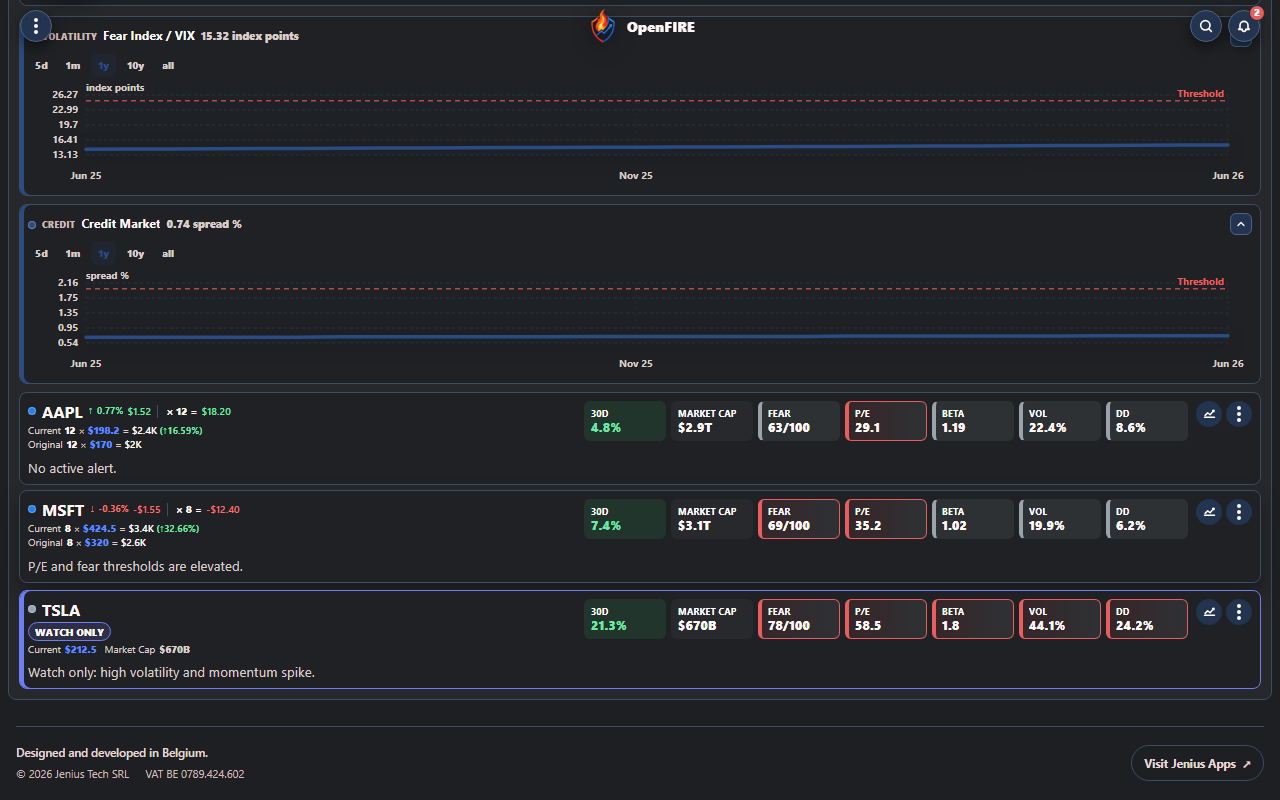
Open Fire shows VIX information and its trend. Cboe’s VIX explanation describes expected S&P 500 volatility over roughly the next 30 days, based on option prices.
That is not a directional forecast. A higher reading does not say whether prices will rise or fall, and a lower reading does not make an individual investment safe. A portfolio concentrated in a particular company or asset can behave differently from the broad equity market.
Compare a trend with today’s observation
Trend charts let investors compare a current market reading with its recent history.
A single gauge gives a snapshot. The trend chart shows whether today’s observation sits within a recent range or follows a larger change. Open Fire lets investors view volatility and credit trends together with holding information.
Check the time range, observation date and available values before making a comparison. A gap in a series or an unavailable provider should remain a gap in your interpretation too.
Credit conditions add another angle, but no single series captures all market risk. Use several observations as context rather than treating their agreement as certainty.
Bring the question back to your holdings
A broad change matters differently for each portfolio. Review position sizes, concentration and the risk fields available for your holdings. Ask whether the market observation is relevant to the exposures you are monitoring.
FINRA’s concentration risk guidance highlights the consequences of large exposure to a particular investment or market segment. A broad index indicator can miss that concentration.
Write a specific review question: “How much of my portfolio depends on this sector?” is more actionable than “Is the market risky today?”
Use alerts as prompts to investigate
Triggered conditions focus the next review on an identifiable position or measure.
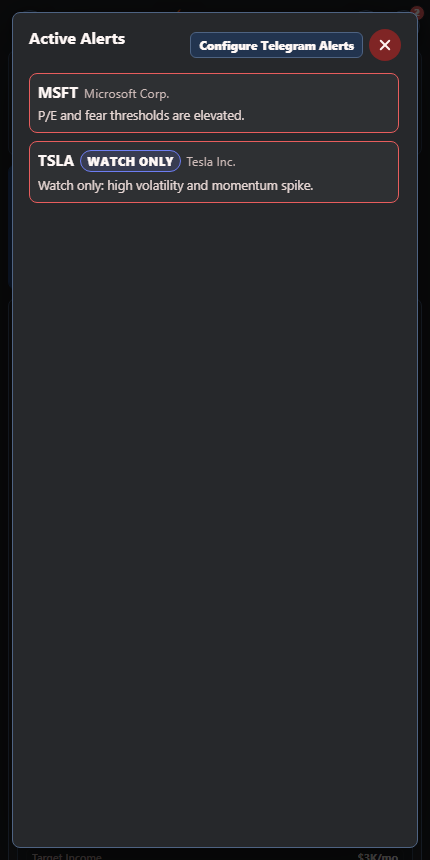
Open Fire’s active alerts bring triggered conditions into a focused view. Inspect the symbol, the reason it appeared and the underlying data. If a measure is unavailable, do not silently replace it with an assumption.
An alert should start a review of facts and your own plan. It should not automatically determine a trade, especially when the information is delayed or incomplete.
Keep the monitoring routine proportionate
Choose a review frequency that fits your investing horizon. Record what changed, what still needs verification and whether any planning assumption needs attention. Rechecking the same gauge constantly does not resolve uncertainty.
Can VIX measure my exact portfolio risk?
No. It describes expected broad U.S. equity volatility, while your holdings may have different exposures.
Does a calm market reading mean low risk?
Not necessarily. Company, concentration, liquidity and other risks can remain even when a broad indicator is quiet.
What should I do with a risk signal?
Verify it, relate it to your holdings and review the relevant assumptions before considering an action.