Explore Retirement Scenarios with Your Portfolio in Open Fire
A guide to using a connected retirement planner to understand which assumptions move a long-term projection.
Jenius Tech SRL
A retirement portfolio planner turns assumptions into a scenario. Open Fire connects portfolio information with contribution, return, inflation and withdrawal settings so you can explore how those assumptions affect a long-range projection.
Use the chart to compare possibilities and identify questions. A smooth line on a screen is a calculation, not a promise about future market returns or income.
Start with the portfolio information
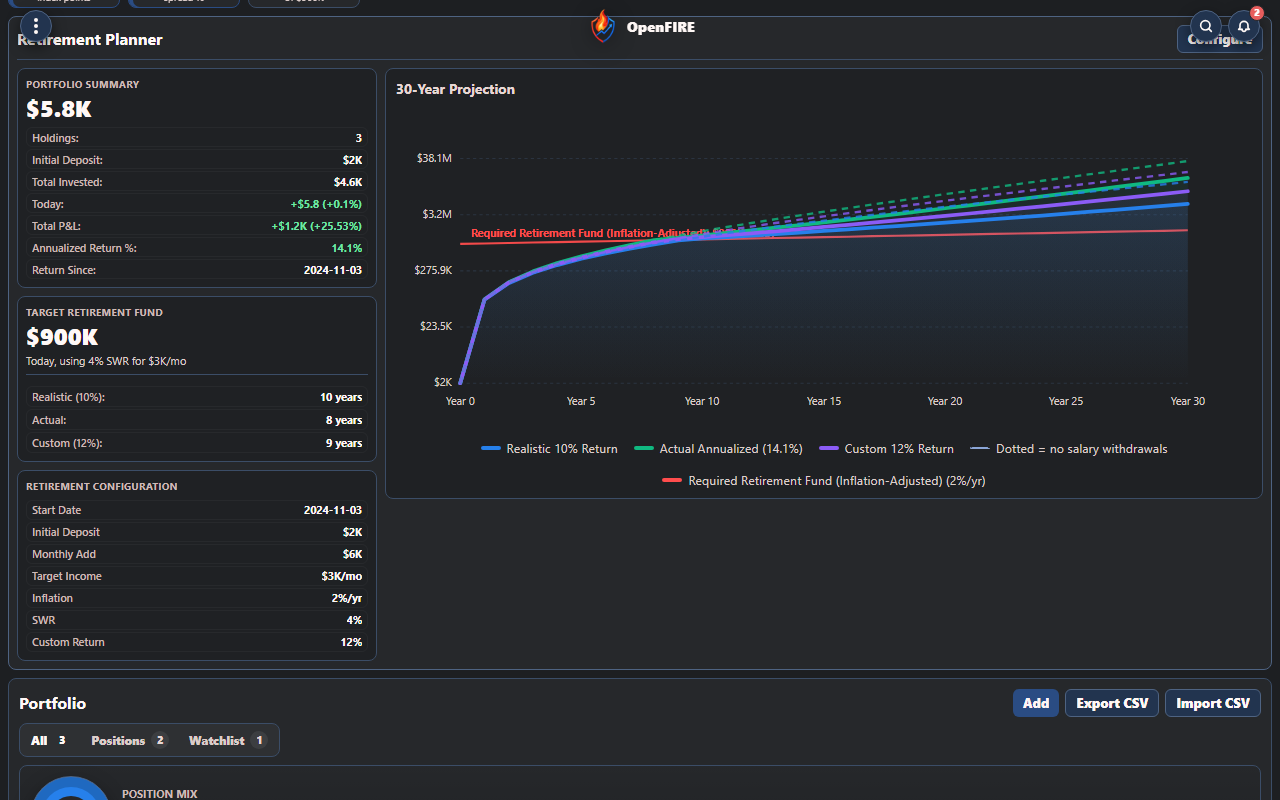
Investors can see portfolio context, planning inputs and projected scenarios in one real app view.
Review the portfolio summary and the recorded initial deposit and investing start date. These inputs affect the performance context shown beside the projection, so reconcile them with your records.
Keep a distinction between observed performance and a future assumption. An annualized return calculated from your recorded history does not establish the rate your portfolio will earn over the next several decades.
Set contributions and income goals explicitly
Open Retirement Settings and review the monthly contribution and desired monthly retirement income. These inputs describe money you intend to add and the income you would like the portfolio to support.
Use amounts that reflect a scenario you can explain. Do not let a default become an unexamined plan. If your contributions are uncertain, compare a lower-contribution scenario as well as your intended one.
Understand inflation and withdrawal assumptions
Open Fire’s settings include yearly inflation and a withdrawal-rate input. Inflation changes the future purchasing-power target, while the withdrawal assumption helps translate desired income into a required fund size.
The interface calls the field Safe Withdrawal Rate. Treat that label as a modeling input rather than assurance that a chosen percentage is safe for your circumstances. Taxes, fees, changing returns and the order of market gains and losses can affect a real retirement plan.
Compare the projection lines carefully
The planner shows return scenarios and identifies dotted lines as excluding salary withdrawals. Read the legend before comparing curves: lines built with different assumptions should not be interpreted as competing forecasts of equal certainty.
For another example of assumption-driven calculation, Investor.gov’s compound interest calculator asks for starting capital, contributions, time and an estimated return. The estimate remains an input to the calculation.
Open Fire’s screenshot shows illustrative saved inputs, including return percentages. The displayed values and labels are examples from the interface, not recommended returns or withdrawal rates.
Change one assumption at a time
The chart supports comparisons when assumptions are changed deliberately and interpreted as scenarios.
Try a lower return, a reduced monthly contribution or higher inflation, then inspect how the target and projection change. Changing one input at a time makes the relationship easier to understand.
Keep a note of the assumptions behind a scenario you want to revisit. A future review is more useful when you can tell whether the portfolio changed, the plan changed or you simply used a different input.
Does the chart tell me when I can retire?
It gives an estimate under the entered assumptions. It cannot guarantee a retirement date or sustainable income.
Can I use my historical return as a forecast?
Historical performance can provide context, but it does not establish future results. Explore different assumptions.
How does this help a portfolio review?
It connects present holdings and contribution plans with a longer horizon, making the consequences of assumptions visible.